
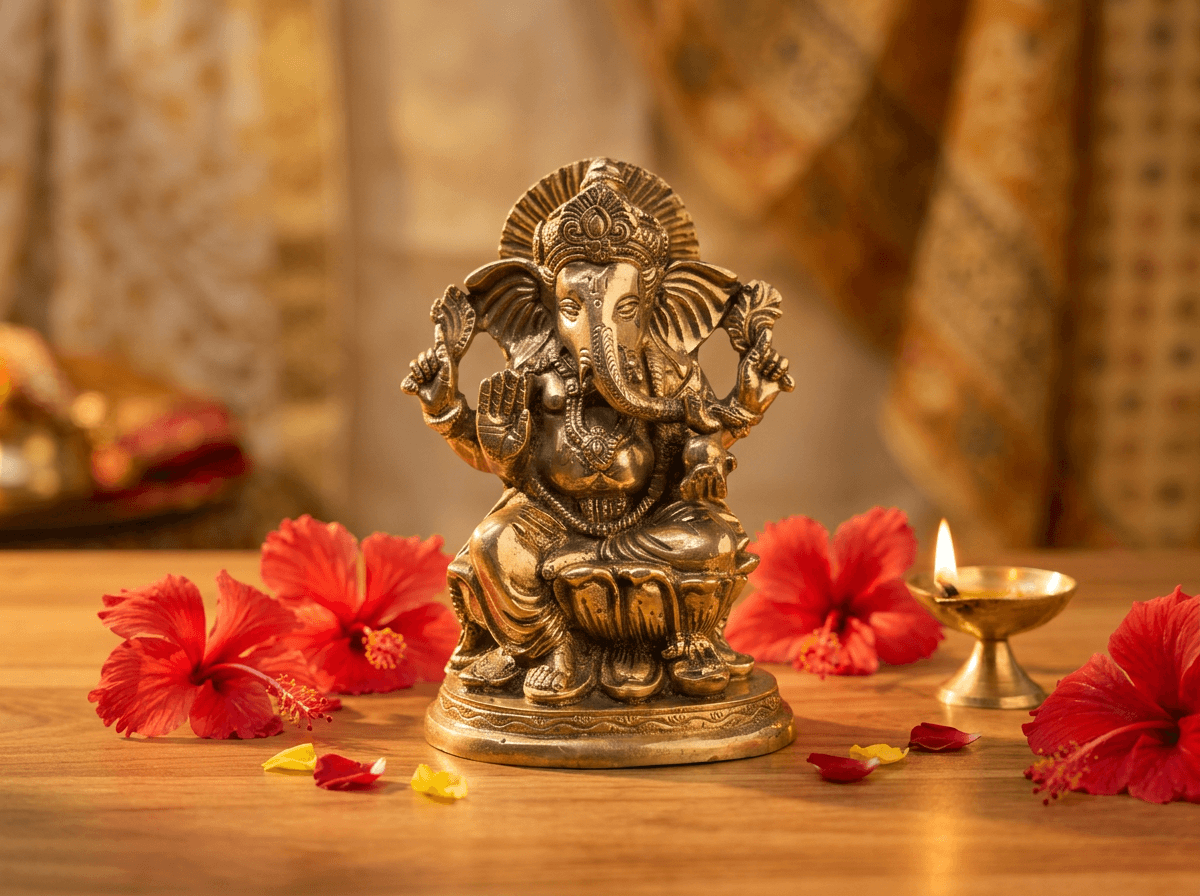
Short answer: a Ganesha murti in brass or carved wood, sized 4 to 7 inches, is the standard Ganesh Chaturthi gift for someone's home altar. Pocket-sized idols (2.5–3 inches) work as return gifts for visitors. Order at least a week before the festival — handmade stock runs out in the final days.
One distinction matters before you buy anything.
Visarjan idols and altar idols are not the same thing
The idol immersed at the end of the festival should be unbaked clay that dissolves in water. Brass, wood and resin do not dissolve, and immersing them causes exactly the pollution that eco-friendly Ganpati campaigns exist to prevent.
Brass and wooden Ganeshas serve the other role: the permanent murti that lives in the home mandir all year. Many families keep both — a clay Ganpati for the ten days and visarjan, and a brass one that stays. If you are gifting, you are almost certainly gifting the second kind, and it is worth saying so on the card so nobody immerses a brass idol out of politeness.
What to give, by relationship
For a family's home mandir
A 4–7 inch seated Ganesha is the sweet spot — substantial enough to anchor an altar, small enough for a shelf. Seated forms with the trunk curving to the left are the traditional household preference. Our antique brass Ganesha on a lotus base and the gemstone Ganesha both sit in this range.
For visitors and return gifts
Pocket and dashboard sizes, 2.5 to 3 inches. They travel well, need no wrapping fuss, and cost between ₹300 and ₹800 — the right register for the stream of people who visit during the ten days. Miniature carved wooden Ganeshas work particularly well here.
For a family hosting their first Ganpati
A larger statement piece, or a Ganesha paired with a brass diya for the aarti. If several relatives are contributing together, an antique-finish idol in the ₹5,000–10,000 range makes a joint gift with real presence.
For colleagues and corporate gifting
Compact brass Ganeshas under ₹1,500, ideally desk-sized. Ganesha is the safest deity for mixed-faith workplaces in India — he is widely read as a symbol of new beginnings and obstacle-removal rather than a sectarian marker.
What to avoid
- Plaster of Paris idols for anyone who intends visarjan — they do not dissolve and are banned in many municipalities.
- Very large idols for small flats. A 12-inch murti needs a dedicated pooja surface; most urban mandirs cannot host one.
- Painted or plated pieces for someone who performs abhishek. If the recipient bathes their idols, only brass will survive it.
- Leaving it to the last three days. Handmade means real lead times, and courier networks are at their worst in the pre-festival week.
Which Ganesha form to choose
The seated Ganesha is the household default — calm, settled, appropriate for daily worship. Trunk direction carries meaning too: a trunk curving to the left (Vamamukhi) is the form kept in homes, considered gentler and more forgiving of ritual imperfection. Right-trunk (Dakshinamukhi) idols are traditionally reserved for temples and stricter observance.
Standing and dancing Ganeshas are beautiful but read as décor rather than altar pieces. They suit a console table or an entrance more than a mandir.
Where the recipient should place it
Worth including on the card, because it is the first thing they will wonder: the mandir or the north-east of the home; the entrance foyer facing inward to welcome guests; or a work desk. Avoid under-staircase placements and anywhere facing a bathroom door. Elevated always, never directly on the floor.
Timing
Ganesh Chaturthi falls in August or September, shifting each year with the lunar calendar. Order at least a week ahead — two if you need a specific piece or bulk quantities for return gifts. We gift-wrap free and include a handwritten note if you leave your message at checkout.
Browse Ganesh Chaturthi gifts and our full range of handcrafted Ganesha idols in brass, wood and antique finishes.
Share:
Housewarming Gift Ideas Under ₹1,000 (That Aren't Another Candle Set)
Diwali 2026 Gift & Decor Guide: Dhanteras to Bhai Dooj