
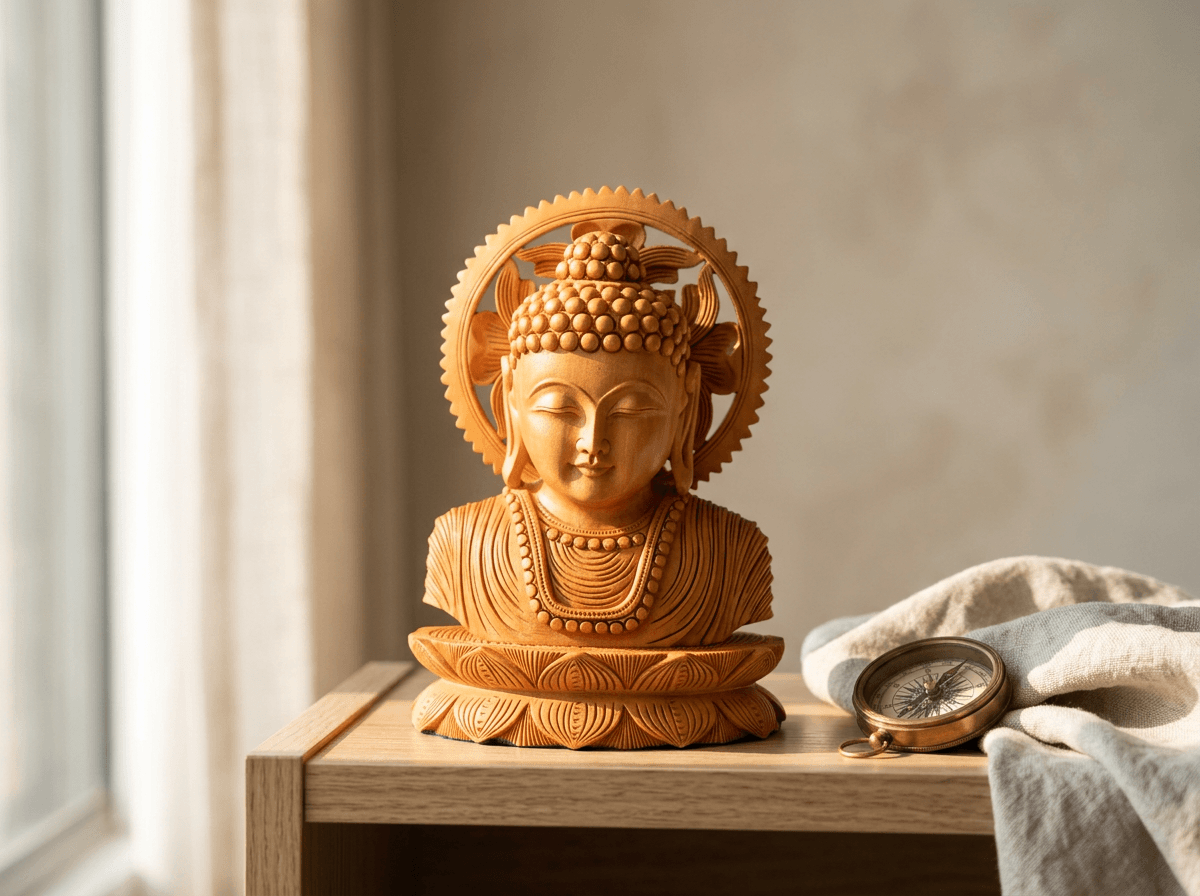
Short answer: place a Buddha idol so it faces east — the direction the Buddha faced at the moment of enlightenment — or position it against an east or north-east wall so it looks into the room. Keep it elevated on a table, shelf or stand, never directly on the floor, and never in a bathroom or facing the foot of a bed.
That covers most homes. But the direction is only part of it, and the questions people actually ask usually go further: which form of Buddha, at what height, in which room, and does any of this matter if you're not Buddhist? Here's the fuller picture.
Why east is the traditional direction
The east-facing convention comes from the enlightenment story itself: Siddhartha sat beneath the Bodhi tree facing east as dawn broke. Placing a statue in the same orientation is a gesture of alignment with that moment rather than a rule with consequences attached.
Vastu Shastra adds a second layer of reasoning. The north-east quadrant, known as Ishanya, is considered the zone of clarity and spiritual energy in a home — the same quadrant traditionally recommended for a mandir. A Buddha placed there is in agreeable company.
If your layout makes east impossible, the practical hierarchy most practitioners follow is: east first, north-east next, north after that. A Buddha facing into the room from any of these is fine. What tradition consistently discourages is a statue facing a wall, a bathroom door, or the underside of a staircase.
Height matters more than direction
If you remember one thing, make it this: the idol should be elevated. A Buddha on the floor, or at ankle height beside a sofa, reads as an ornament rather than an object of respect — and this is the placement error people regret most once it's pointed out to them.
Practical guidance: position the statue at or above the eye level of someone seated in the room. A console table, a mantel, a dedicated stand, or a raised shelf all work. In a meditation corner, a low platform is acceptable because you are seated on the floor too — the relationship between your eye level and the statue is what counts, not the absolute height.
Which Buddha form for which room
The form changes the mood of the space more than most people expect.
- Meditating Buddha (dhyana mudra) — hands resting in the lap, eyes lowered. The calmest of the forms and the natural choice for a meditation corner, a reading nook, or any room where you want the temperature to drop a few degrees. Our wooden meditating Buddha on a lotus base is the classic expression of this.
- Blessing Buddha (abhaya mudra) — right palm raised outward, the gesture meaning "fear not". Traditionally associated with protection and reassurance, which is why it is often chosen for entrances and living rooms where guests arrive. The brass blessing Buddha suits an altar or console setting.
- Buddha head or bust — a contemplative art piece more than a devotional one. It sits comfortably in interiors where a full figure would feel too devotional, and works well on bookshelves and sideboards. See the 8-inch carved Buddha head.
Rooms to avoid, and why
Three placements come up repeatedly as ones to avoid, and each has a straightforward rationale rather than a superstition behind it.
Bathrooms and directly outside bathroom doors. The objection is about cleanliness and respect, and it is consistent across Indian household traditions for any devotional object.
Facing the bed. Bedrooms are private spaces; tradition holds that devotional figures should not directly face a bed. If you want a Buddha in the bedroom, a decorative head on a dresser, angled away from the bed, is the usual compromise.
Under a staircase. Placing a statue where people walk above it is considered disrespectful — the same reasoning that puts the mandir away from staircases.
Is it appropriate to keep a Buddha if you're not Buddhist?
This question deserves an honest answer rather than a marketing one. A Buddha statue kept thoughtfully — elevated, clean, in a calm part of the home — is widely regarded as respectful regardless of the owner's faith, and Buddha figures have been part of Indian, Chinese and South-East Asian domestic decoration for centuries across religious lines.
What draws genuine criticism is treating the figure casually: a Buddha head used as a doorstop, placed on the floor of a bathroom, or set beside a shoe rack. The distinction people care about is not belief but care.
Wood or brass?
Both are traditional; they simply behave differently in a room. Carved wood reads warm and organic and suits living rooms, studies and bedrooms, needing nothing more than a dry dusting. Brass catches light and holds intricate detail, which makes it the better choice for altars, console tables and any spot where you want the piece to draw the eye. Brass will darken over time — that is patina, not damage, and it polishes back whenever you choose.
A simple checklist
- Face the statue east, or north-east, looking into the room
- Elevate it to at least seated eye level
- Keep the surrounding surface uncluttered — one Buddha in a calm corner beats three competing for attention
- Avoid bathrooms, bed-facing positions and under-stair placements
- Dust regularly; treat the space around it as you would a mandir
Browse our handcrafted Buddha idols in carved wood and solid brass, each made by artisan families across India.
Share:
How to Clean Brass Idols at Home (And What Never to Use)